A Lid on the Pot, or Open to the Air?
Covered or uncovered simmering changes how steam leaves the pot. Choose a lid position to retain broth, control splashes or let sauce reduce without guesswork.
The common mistake with covered or uncovered simmering is choosing a lid position once and leaving it there. A tight lid can return steam to a sauce you want to thicken; an open pot can lose the moisture a braise or pot of beans needs. Use the lid to manage where steam goes, while treating heat as a separate control.
Choose the lid by the steam you want to retain
A lid catches steam and lets some condense on its underside, where it drips back into the pot. Without a lid, more vapour escapes into the kitchen. That difference affects the amount of liquid in the pot and how readily splashes reach the hob.
Cover when retaining moisture matters, as with a broth or a braise that should not dry out. Leave the pot open when you want excess liquid to escape. Resting the lid askew creates a middle setting: steam can leave through the gap, but the pot remains partly sheltered.
The lid does not control simmering by itself. A broad saucepan lets more liquid surface meet the air than a narrow, deep pot. Heat level affects the movement of steam, while the shape and fit of the lid determine how much escapes around its edge.
Use the lid to manage condensation and splashes
Condensation on the underside of a lid tells you that steam is gathering there and returning to the pot. If those drips are unwelcome—for example, in a sauce you are reducing—set the lid aside or leave it slightly open. If splashes are landing on the hob, a lid can act as a shield, but lower the heat if the pot is bubbling forcefully.
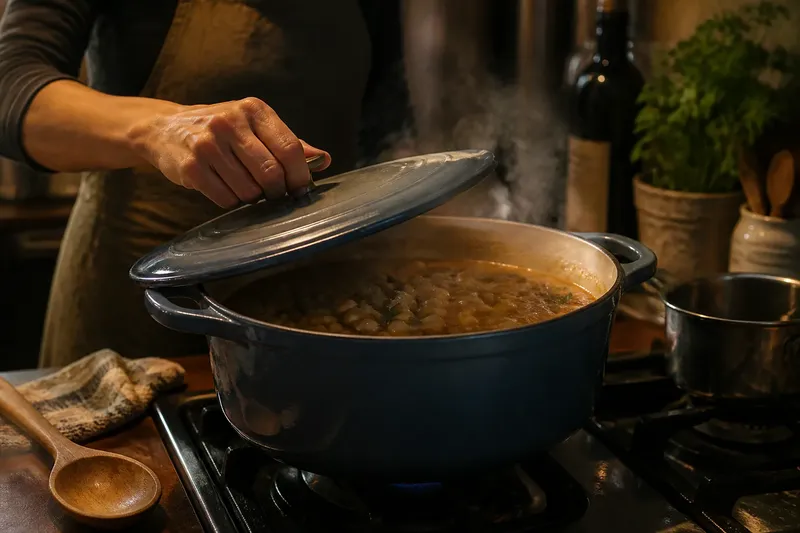
Lift the lid carefully and tilt it away from your face so trapped steam escapes in the opposite direction. Avoid hovering over the opening. Set a hot lid on a heatproof surface, with its handle clear of the edge of the hob.
A covered pot may bubble quietly, so sound alone cannot tell you whether the contents are sticking. If the mixture is thick, lift the lid and run a wooden spoon or silicone spatula along the base. A clean path that fills slowly suggests the sauce is thickening; food clinging to the pan calls for a stir and a check of the heat.
Set a cracked lid safely
Rest the lid askew on a stable part of the pot rim, leaving a gap for steam. Check that it cannot slide towards the burner or obstruct a handle. If the lid rattles or shifts, remove it rather than balancing it in an unreliable position.
A wooden spoon is sometimes used to prop open a lid, but it can move, become hot or make the lid unstable. A lid designed with a vent is another option, though it still needs to sit securely on the pot. If neither arrangement feels steady, cook uncovered and adjust the heat or move the pot to a smaller burner.
Match lid position to the dish
- Broth: If you want to keep the liquid level steady, cover the pot; if the broth tastes weak and there is excess liquid, uncover it to let some escape.
- Tomato sauce: If splashes are reaching the hob, cover the pot or leave the lid askew; if the sauce is thinner than you want, uncover it and stir along the base.
- Beans or lentils: If the pulses sit in too little liquid before softening, cover them and add suitable cooking liquid; if tender pulses are surrounded by excess broth, uncover the pot to let steam escape.
- Stew: If the pieces need moist cooking, cover the pot; if the liquid is looser than you want near serving, uncover it and stir the base occasionally.
- Grains cooked by absorption: If the method depends on trapped steam, keep the lid in the position specified by the recipe; if the grains are cooked and steam is clouding their surface, uncover them as directed by that method.
- Thick sauce: If the sauce begins sticking at the base, stir and lower the heat before deciding on the lid; if it is stable but too loose, leave it open or cracked to release steam.
How should you change the lid position?
What should you do if liquid is vanishing too quickly?
Lower the heat and replace the lid fully or partly to slow steam loss. If the ingredients are exposed or sticking before they are tender, add cooking liquid suited to the dish and stir gently.
What should you do if a sauce remains too loose?
Leave the pot open or cracked so steam can escape, keeping the simmer controlled. Stir thick sauces along the base and stop when the texture suits the dish.
Should you stir more often with the lid off?
Not necessarily: a thin broth may need little stirring, while a thick sauce can catch as it reduces. Check whether food is settling or clinging to the base, then stir if it is.
Can you cover a pot that is boiling hard?
Lower the heat first and wait for the forceful bubbling to settle. Then cover it if retaining steam or containing splashes suits the dish.
Work through a lid change one decision at a time
Say you are cooking chickpeas in a seasoned broth. The chickpeas are still firm and several sit above the liquid, so you add suitable broth and cover the pot to limit further steam loss. Later, imagine the chickpeas are tender but the serving liquid still runs thinly off a spoon: you leave the lid askew and stir along the base. When the broth clings lightly to the spoon, you remove the pot from the heat. The decisions follow visible changes in the liquid and the lid’s effect, rather than a fixed lid position.
Make one adjustment, then check whether steam is escaping where you intend and whether the lid remains stable. For covered or uncovered simmering, the useful distinction is not simply wet or dry: the lid can retain moisture, return condensation, contain splashes or allow steam to leave. Choose the function the pot needs, and keep the lid safely placed while you work.