Why a Recipe Is Not a Stopwatch
Recipe timings are useful prompts, not promises. Learn which cues to check so you can adapt a method to your ingredients and make a confident cooking decision.
The common mistake with recipe timings is to treat the stated minutes as a promise: keep cooking until the clock says so, then serve. That can leave a dish overdone or still short of ready, because ingredients, pans and heat behave differently from one kitchen to another. Recipe timing is a planning tool; the real question is whether the method has reached its intended stage.
Rather than repeatedly checking whether food is done, use timing to manage the sequence of a recipe. A timer can remind you to add the next ingredient, turn a tray or begin preparing a side dish. When the instruction names a visible event, such as bringing liquid to a boil or adding vegetables after the onions soften, let that event—not an assumed duration—set the sequence.
Use recipe timing to organise the cooking sequence
Recipe writers give timings so you can plan the work and understand how stages relate. Your hob, pan and ingredient preparation may differ from the ones the writer had in mind, so the duration is best treated as an estimate for scheduling rather than a deadline for serving.
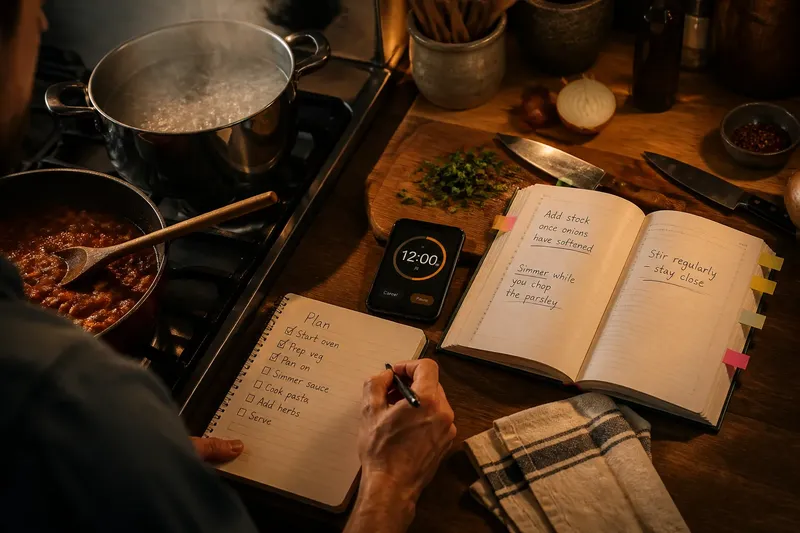
Read the method before you start and identify which instructions are time-based and which are event-based. “Simmer while you chop the parsley” gives you a useful overlap. “Add the stock once the onions have softened” makes the onions’ change in texture the cue for the next action.
Use a phone timer, kitchen timer or the clock on your cooker for reminders that protect the sequence. If a timer rings while you are doing another task, check what the recipe asks you to do next. It may be time to stir, add an ingredient or turn down the heat—not to decide that the dish is finished.
Choose a timing method that suits the task
Some instructions need close attention; others can run while you prepare something else. Match your use of the clock to the role of that stage in the recipe.
Set reminders for short, attention-sensitive tasks
Use a timer when a task can change quickly or when you need to return to the pan at a particular point. Toasting spices, warming garlic in oil or cooking a thin pancake are examples. A reminder helps you stay present without making the stated duration a substitute for looking at the food.
Use longer timings to plan other work
For a stew or a tray of vegetables, the recipe’s timing can help you decide when to prepare the table, wash a chopping board or start another component. Set a reminder for a sensible point in the method, then use the recipe’s instructions to decide what action follows.
Do not fill every pause with another task if you need to attend to the pan. For a sauce that needs regular stirring, stay close enough to do that; a timer cannot do the stirring for you.
Keep a recipe’s timing when it protects the order
Some durations are there to coordinate actions rather than declare doneness. A recipe might ask you to simmer a sauce while pasta cooks, or to rest dough before shaping it. Keep those timings in view, then follow the named next step and any relevant description of the food’s state.
What should you do when a recipe gives only minutes?
How do I know what action follows a timer?
Read the next sentence in the method before the timer rings. If it says to add an ingredient, lower the heat or stir, treat the alarm as a prompt for that action rather than a signal to serve.
Should I set a timer for every stage?
No. Set one when it will help you return at the right point, keep a sequence straight or avoid leaving a short task unattended. For a stage that needs continuous stirring or attention, stay with the pan rather than relying on an alarm.
What if the stated time has passed but the next step is not ready?
Check the instruction’s purpose and continue the method at a pace that suits the food. If the next action depends on a named change, such as softened onions, wait for that change rather than moving on solely because the timer rang.
How can I make timing easier the next time?
After cooking, note where a reminder would have helped or where two tasks could be coordinated more smoothly. Record a practical detail such as “set a reminder before draining the pasta”, rather than turning one kitchen’s timing into a fixed rule for every attempt.
Read the method for actions and hand-offs
A recipe often contains small hand-offs: finish chopping before the pan needs attention, add the next ingredient after a named change, or start a side dish while the main dish simmers. Mark these points mentally or with a note on the recipe. They help you move through the method without treating each duration as an isolated command.
If you are cooking from a website, keep the recipe open on your phone or print it and mark the next action with a pencil. On a printed recipe, a short note such as “chop herbs during simmer” can be more useful than writing down how long the simmer took. It tells you what to do with the time.
- Check the next instruction: If it names an action such as stirring or adding stock, do that; if it names a food change, wait for that change before moving on.
- Check whether the stage needs attention: If the recipe calls for frequent stirring, stay by the hob; if it allows an unattended simmer, use the interval for a suitable preparation task.
- Check whether another component depends on this one: If the sauce and pasta should finish together, coordinate their start points; if they do not depend on each other, prepare them in the order that keeps each manageable.
- Check whether the timer is a reminder or an endpoint: If it marks a change of action, follow that instruction; if the recipe describes a desired result, use that description to decide whether to proceed.
- Check the next task before starting another: If you can pause the new task safely, begin it; if it would distract you from a pan needing attention, wait until that stage is under control.
- Check any food-safety instruction: If the recipe or product label gives a safety requirement, follow it and use a suitable thermometer when recommended; if the food is safety-sensitive and the instruction is unclear, consult recognised local food-safety guidance.
Plan overlapping tasks without losing your place
Cooking several components at once can make timings useful, but only if you know which task deserves your attention. Write a short sequence on a scrap of paper: start the oven, prepare vegetables, put the pan on, then begin the side dish when the main pan is stable. Keep the list focused on actions and hand-offs, not a minute-by-minute schedule that becomes difficult to follow when something runs late.
Say you are making a hypothetical lentil soup and flatbreads, and the recipe says to simmer the soup while you mix the dough. You prepare the dough after the soup reaches a steady simmer, set a reminder to return for the next stir, and then continue with the flatbreads only if the soup does not need constant attention. If the reminder sounds while the dough is still being mixed, you pause at a safe point, tend the soup, and resume; the useful result is that both tasks stay in the right order without forcing the soup to match an arbitrary clock.
Keep recipe timing as a guide to when you should prepare, return or change tasks. A well-placed reminder protects the order of the method; a clear instruction tells you what to do when it rings. Before you start, identify the next action at each timer point, and you will spend less effort watching the clock and more attention on the cooking in front of you.